



The COVID-19 pandemic disrupted nearly every aspect of commerce, including the food supply chain sector where bottlenecks caused prices to spike and, in many cases, prevented businesses from obtaining goods to maintain operations.
It was a wake-up call, especially for those responsible for moving temperature-sensitive goods, that there were significant global vulnerabilities in cold storage infrastructure and cold chain logistics. In a 2023 article that announced the opening of the first phase of a cold storage facility in Lebanon, Boone County, Jonas Swarttouw, EVP and chairman of NewCold in North America, referred to the global COVID-19 pandemic as a period that “underlined the importance of building resilience into the supply chain of leading food companies in the US.”
In the five years since the initial shutdowns, NewCold and other industry leaders have been working to strengthen the cold storage and logistics sector’s position in the Midwest through strategic expansion and modernization.
New Facilities
Netherlands-based NewCold started operations in Lebanon in 2022 with an initial investment of $150 million for a cold storage facility. With another $150 million investment, the company announced the completion of Phase 2 of the project in early 2025, doubling the facility’s capacity to over 380,000 square feet, making it among the largest in the world. The facility is operational 24 hours a day and capitalizes on technological automation and renewable energy to run more efficiently and boost sustainability.
PL Cold and Ambrose Property Group partnered to construct a 300,000-square-foot deep-freeze warehouse in Greenfield, Hancock County. The large facility, which opened in December 2023, also uses the latest in advanced technology to streamline operations.
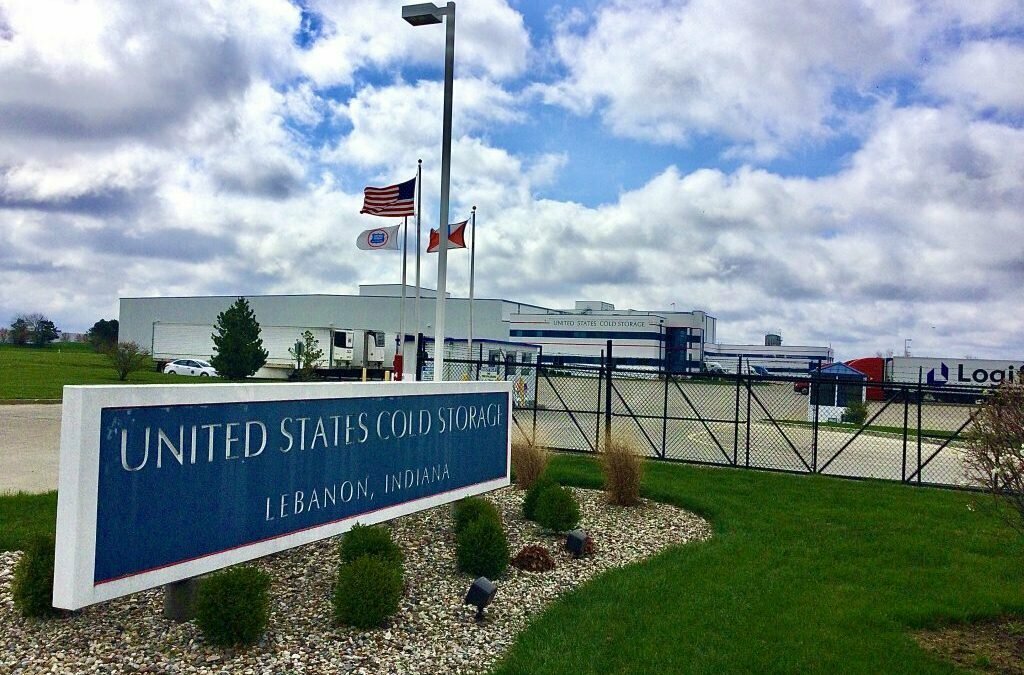
To the north, significant cold storage development has also taken place over the last several years. In the fall of 2023, United States Cold Storage broke ground on a $124 million facility in Hebron, Porter County. The company’s 13.5 million cubic-square-foot refrigerated warehouse stretches across 70 acres, with room for trailers and dock areas. A few miles west in Lake County, work is finishing up on an expansion of Lineage’s site along Northwind Parkway in Hobart. The company announced last year plans to expand to include a fully automated 188,000-square-foot warehouse, which is expected to be completed this year.
Another Lake County cold storage facility was opened at the end of 2024. CORE X CROWN is a state-of-the-art, 215,000-square-foot cold storage and logistics facility. The project is the first of three phases. At completion, CORE X Partners said the facility will span 450,000 square feet in a $200 million investment to the Northwest Indiana community.
While cold storage development has been slower in the southern counties of Indiana, planned projects, like the news of a possible King’s Hawaiian manufacturing facility in Bartholomew County, could bring additional need for temperature-controlled facilities in those regions.
Economic Win
The cold chain logistics global market size is expected to grow at a compound annual growth rate of 15.3%, with industry analysts projecting a value of $1.19 trillion by 2034. Aside from the lessons learned through inadequacies discovered during the pandemic, there are other driving factors to the growth. One is supply for projected demand. Development in cold chain logistics is currently keeping pace with a rapidly advancing e-commerce market. The demand for cold storage will continue to drive additional development as needs increase.
Technology that automates processes and improves efficiency for cold chain logistics is also advancing the market, allowing industry leaders to turn to cleaner and more efficient energy sources and operations that save money and time.
Indiana and the Midwest region appeal to developers due to strong existing infrastructure, including major highways and rail service, as well as the proximity to major cities like Chicago and Detroit. Strong local and state support has been given for cold storage operations and associated infrastructure needs in Indiana, including some funding from the state’s Regional Economic Acceleration and Development Initiative.
As a result, hundreds of new jobs in warehousing and logistics have been created from cold storage developments and new revenue is helping to strengthen the economy with local, state and regional impact.


